
Animal welfare
Flock management
Herding dogs have been used by shepherds since Roman times to move flocks from one place to another, as they are the most efficient and safest method for sheep.
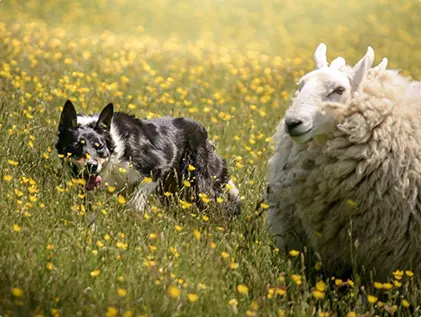
The intention of a shepherd and their dog is to move the sheep with the greatest calm and least stress possible, in order not to cause them any danger. Sheep must be handled calmly to prevent them from fleeing and starting to run in any direction, possibly getting lost in the countryside. This is why shepherd dogs approach the sheep slowly so that they walk calmly in the correct direction. In trials, the handler and dog must demonstrate with their skills that they can perform these difficult tasks. Points are earned when the sheep move under control, in a straight line and with minimal excitement. Dogs are handled carefully to ensure both the welfare of the sheep and their own. The sheep must be healthy and fully capable of completing the course through the trial field.
When a trial ends, which lasts about 20 minutes, the sheep are taken to an adjacent field where they join the rest of the flock and a different group of sheep is brought out for the next competitor.
Herding dogs love what they do. The instinct, focus and obedience they show is a testament to how much they enjoy working with their owner. On a farm they could be working perfectly for 8 hours straight with their owner, but in a trial 20 minutes are sufficient to demonstrate their ability.
All trials are supervised by a responsible person (designated by the Association) who will ensure that the sheep are healthy and calm. They will also monitor that the dogs are in good health and behave correctly. If any of these guidelines are altered, the removal and replacement of the sheep will be considered, and in the case of dogs, their continuation or withdrawal from the trial will be evaluated and decided.
It is the responsibility of the Association and its members to maintain the highest standards of animal care at all times.
Hereditary diseases in dogs
It is known that since the end of the 19th century, through genetic selection, humans have been modifying and accelerating the evolutionary process of dogs with the aim of obtaining new breeds. Fashion, unique morphologies, behavior, temperament and other characteristics of interest to humans were determining conditions when choosing the "most suitable dog for coexistence"
As a consequence of continuous genetic selection work, new dog breeds appeared with morphological and behavioral characteristics according to those sought by different breeders. However, the processes used to fix these highly desired traits also led to the fixation of unwanted characters and/or mutations, which are not observable with the naked eye, such as hip dysplasia in shepherd dogs, or speaking of other types of dogs, another example of fixation of unwanted characters would be epilepsy in Bull Terriers. Not being initially observable, these characters were transmitted to subsequent generations.
After the sequencing of the canine genome and association studies, some genes that cause or predispose to some canine diseases have been identified. The results showed that in some cases maintaining pure or homogeneous breeds by crossing between closed or small groups to fix desired traits, have predisposed some of them to be susceptible to certain diseases or anomalies.
With the genetic information available today, the best way to control hereditary diseases, in a large number of breeds, is to perform DNA tests in order to genotype and identify changes or mutations at early ages and better if it is before they are inherited through inappropriate crosses. It is therefore important that veterinarians handle this information and advise their clients in order to make appropriate matings that allow the reduction and/or elimination of such diseases.